Beyond Beijing: Rethinking Women’s Political Participation is a research project implemented by the European Democracy Hub in partnership with Club de Madrid, exploring the global progress made in aiding women’s political participation since the adoption of the Beijing Declaration and Platform for Action in 1995. As part of this project, the European Democracy Hub interviewed Aminata Touré, Prime Minister of Senegal (2013–2014) and Member of Club de Madrid.
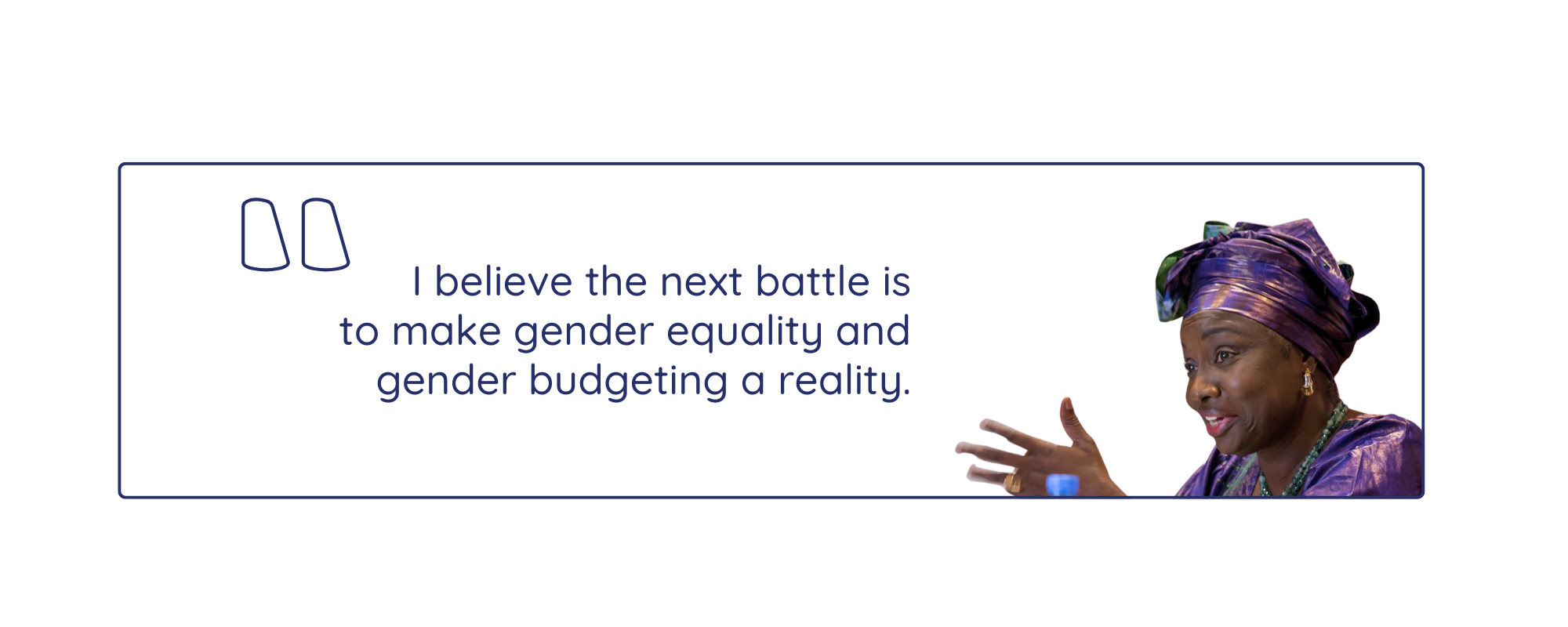
Could you share specific initiatives or policies from the Beijing Platform for Action that you helped implement or advocate?
Senegal is recognised for having one of the highest representations of women in parliament. At the moment, over 40% of Senegalese parliamentarians are women.
This is the result of one of the legislative initiatives we have implemented. We introduced legislation mandating gender parity in electoral lists. This legislation stands out not only in Africa but globally. The law mandates that election lists, whether municipal or legislative, must consist of 50% men and 50% women. Importantly, according to the legislation, men and women cannot be listed in a hierarchical order, with men at the top of the list and women at the bottom; instead, it requires an alternating structure. Now in place for 14 years, this law has driven remarkable progress in women’s participation in elected positions, including in parliament.
How have societal or cultural norms affected women’s ability to participate in decision-making?
We still have cultural norms of patriarchy, which are not specific to Africa. We still suffer from violence against women. It’s still prevalent – worldwide. We still face female stereotyping. However, Africa has the chance for transformation; we have a very young population – the average Senegalese person is 19 – so we can change norms, practices, and culture with the new generation emerging. That explains why progress is happening very quickly. In terms of norms, we are also witnessing the universalisation of thinking and behaviour.
As regards participation in decision-making, as mentioned, we have legislation mandating gender parity in the legislature. However, when it comes to the cabinet, the number of women is lower. Therefore, we need to revise the law to expand the scope of gender parity from elected to nominated positions.
Have international frameworks for monitoring progress been effective in advancing women’s political participation?
I believe that the Commission on the Status of Women has been effective in monitoring progress. Countries report on their advancements and gaps, and the monitoring is quite well done. I also commend the work of UN Women for following this closely. However, I still believe that it ultimately comes down to political will, and it is up to governments to push forward. Donors also have a role to play in supporting local women’s organisations, as they have been at the forefront of the fight for progress, and in holding governments accountable.
I pay tribute to the women in Iran who risked their lives fighting for their rights and justice. This powerful movement was driven by civil society organisations. Therefore, it is crucial to support them – not only financially but also in other ways, especially politically. They need political backing to push progress forward so that equality and equity become a reality – not just for educated or urban women, but for all women, including the most vulnerable.
Yet, the advancement of women at the national level is not going to depend on donors. It must be an investment by the government, which must work towards changing society’s mindset. Parliamentarians need to vote on laws that have nothing to do with donors. It’s all about political commitment. That’s why I emphasise the importance of supporting women’s organisations, because they do the groundwork, and they need the resources to continue that work.
What is your opinion of the role of men in advancing women’s political participation?
This is a key question. The UN has #HeforShe, a global solidarity movement for gender equality, and I think that is wonderful. Because when we think about who we want to change in terms of behaviour and mindset, it’s men – they need to see women as equal partners. Therefore, it’s crucial to make the next priority bringing more men into the women’s movement. This should begin at an early age, from kindergarten onwards. We should teach boys that girls are their peers, that they are equally intelligent, have the same rights, and are equally capable.
When we are among ourselves, we are all against violence against women, but it is the perpetrators who need to change their mindsets.
What advice would you give to female leaders?
They say, put your money where your mouth is, so invest where women are. This is a crucial step in driving successful strategies. It is also essential that we don’t take progress for granted but continue to push forward. Unfortunately, we witness setbacks, which is why we must stay vigilant and have alert systems in place to counter any attempts by countries to move backwards.
However, more important than financial resources is political will. You don’t need money to transform the law – it comes with will and commitment. To push this political commitment forward, women must come together and make it a central issue in all elections. Women’s rights should be at the heart of every campaign. I believe that for the next decade, we must adopt a more proactive stance, as this is what will drive the progress we seek.
This interview was conducted with the financial support of Club de Madrid as part of the “Beyond Beijing: Rethinking Women’s Political Participation“
Image: © Wayamo Foundation, flickr (CC BY-SA 2.0)