Beyond Beijing: Rethinking Women’s Political Participation is a research project implemented by the European Democracy Hub in partnership with Club de Madrid, exploring the global progress made in aiding women’s political participation since the adoption of the Beijing Declaration and Platform for Action in 1995. As part of this project, the European Democracy Hub interviewed Carlos Alvarado, President of Costa Rica (2018–2022) and Member of Club de Madrid.
Does the multilateral system have effective mechanisms for fostering gender equality and women’s political empowerment?
I believe international mechanisms are effective to some extent, mainly in putting gender equality on the political agendas of countries around the world. However, local ownership and political commitment are most important, because the multilateral system does not necessarily have a coercive enforcement mechanism. The system is definitely effective in helping countries develop action plans and in putting pressure on governments to act and deliver on their commitments.
But sometimes, the system itself needs to evolve and change. For example, the question of appointing a female UN secretary general is significant. We need to make progress and abandon certain outdated practices, and this is not just a task for the developing world. If you’re pushing for change, it’s best to lead by example, and the UN must uphold that standard.
That said, I believe the Beijing Platform for Action created real political momentum and a follow-up process that incentivised many countries around the world. It also coincided with a period when more talented women entered politics – not merely suggesting change, but demanding it. For instance, one female politician in my country used to say, “You don’t have to wait to win an election to do what’s right.” Her logic was very robust, and when you’re faced with a compelling argument like that, either you act or you become a hypocrite.
What is the most important aspect of fostering gender rights? Is it about human and financial resources?
Yes, resources are important. However, in many countries, especially in the developing world, gender rights are not a top priority. In practice, this means that incremental resources are rarely available. So, you often have to work with what you have. For example, the Ministry of Women was created in my country, but during my campaign, the opposing candidate wanted to close it and turn it into the Ministry of Family. That’s a real example, and it shows that progress challenges the status quo – and not everyone supports meaningful change.
What I would argue is that while resources matter, the most important requirement is political will and awareness. That’s the key. I still see certain influential boards in the private sector where, when you look at the members, it feels like a mid-20th-century men’s club. This shows that progress has been slow and incremental, and we need to work more seriously to see real change.
How should harmful gender stereotypes be addressed in society?
It does not have to be a dichotomous approach of men versus women, but rather a question of what is best for society as a whole, including the family and the home. There is no data to suggest that a better society is one in which men dominate. I truly believe that a better society for both men and women is a more equal one – because both men and women are happier in such a society.
We must continuously develop and shape our societies. The media, including social media, play an important role in this – particularly in shaping and promoting the kind of society we aspire to. For example, films and television series often reflect this influence. When I watch an old film from the 1970s, ’80s, or ’90s, I sometimes notice language or jokes that are now clearly unacceptable.
Civil society also has a responsibility to mobilise and raise public awareness. However, media can have a negative impact too. I have seen some influencers on social media promoting toxic masculinity and presenting a macho image that many young men begin to mimic because it makes them feel empowered. This is where education and civil society must step in – to offer facts, promote critical thinking, and help people identify the kind of societal model that delivers benefits for everyone.
Why is it important to remain vigilant in the fight for gender equality, even when progress seems to be under way?
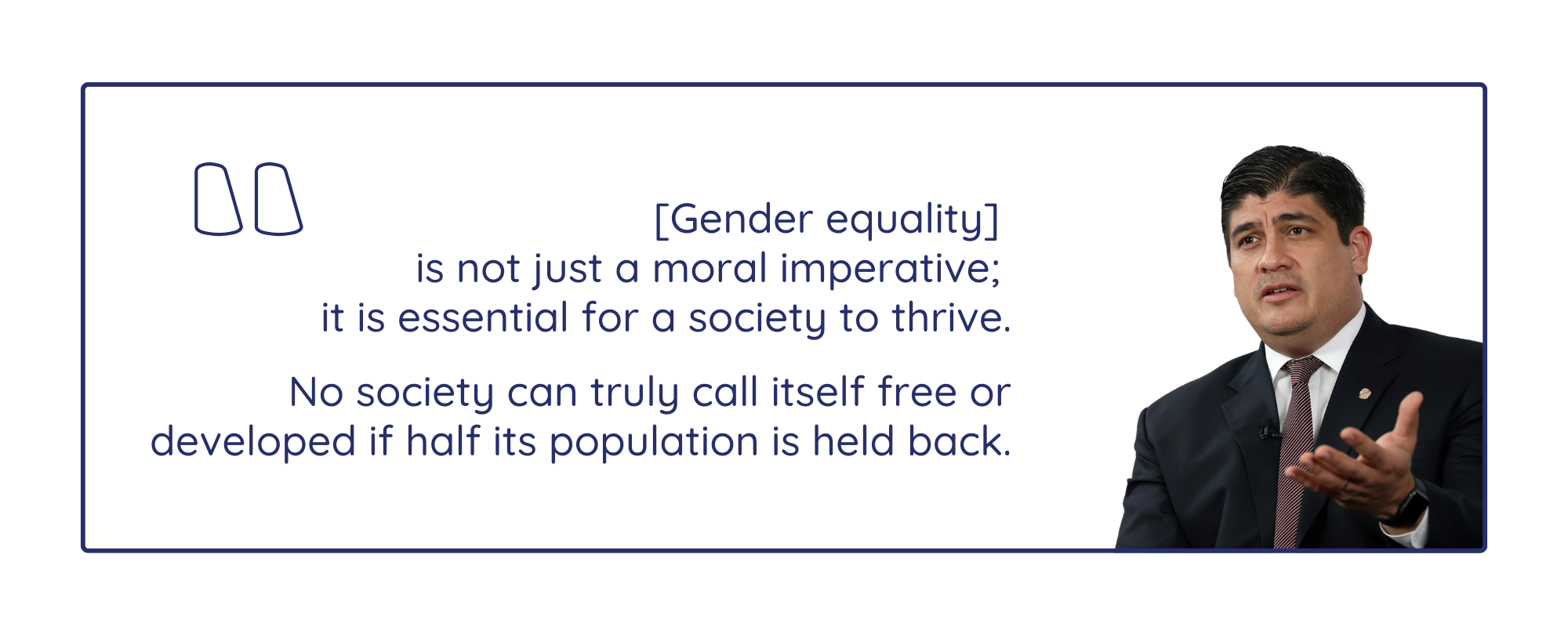
The current push for gender equality is fundamentally shaking up the long-standing status quo, and that disruption is provoking resistance. It’s important to recognise that progress is not inevitable: history shows us that rights can be gained and then lost. Societies where women once had access to education and freedom have, at times, reversed course. That is why we must actively defend and explain the value of gender equality. It is not just a moral imperative; it is essential for a society to thrive. No society can truly call itself free or developed if half its population is held back. Real progress depends on both men and women advancing together.
This interview was conducted with the financial support of Club de Madrid as part of the “Beyond Beijing: Rethinking Women’s Political Participation.”