Beyond Beijing: Rethinking Women’s Political Participation is a research project implemented by the European Democracy Hub in partnership with Club de Madrid, exploring the global progress made in aiding women’s political participation since the adoption of the Beijing Declaration and Platform for Action in 1995. As part of this project, the European Democracy Hub interviewed Tarja Kaarina Halonen, President of the Republic of Finland (2000–2012) and Club de Madrid Member.
What do you consider to be the most significant achievement in advancing women’s leadership over the past 30 years?
Progress has varied across countries, but I would say one of the most significant achievements has been the gaining and consolidation of political rights for women. Women’s rights have become a mainstream issue in policy sectors worldwide, and there is now a broad global consensus on the importance of advancing women’s rights. I have a long-term perspective on this, having been active since the late 1960s. Even as a student, equality was already a central concern, but breaking barriers to top positions—particularly outside politics—was extremely difficult.
The Beijing Conference in 1995 produced surprisingly strong results and brought the fight for women’s leadership into the global spotlight. That year, I was appointed Finland’s first female Foreign Affairs Minister, having previously served as Minister of Social Affairs and being nominated as Minister of Justice. These were significant milestones at a time when women holding such positions in other countries was still rare.
Yet progress can be uneven. For example, after my tenure, the next female Foreign Affairs Minister in Finland was only appointed almost 25 years later. This shows that efforts to promote women in leadership must continue.
Later, I became Finland’s first female President, and I remain the only woman to have held that office so far. Since then, the number of female presidents has increased globally, though not dramatically. In Finland, the transformation in government composition has been striking. In the 1980s and 1990s, only a few women served as ministers. By contrast, the coalition government under Prime Minister Sanna Marin had five political parties, and all the party leaders were women—a historic turn. The current conservative-right government includes 19 ministers, of whom 11 are women, showing that this trend is continuing. A new tradition of women in politics has clearly been established, and while there is still work to do, the trajectory is positive.
What do you consider the most influential initiative or policy in advancing women’s political leadership?
I would say the Beijing Platform for Action has been the most impactful. It forced the global community to recognise that women’s rights are not a niche or marginal issue, but are central to all political decision-making. In my view, that alone represents a major achievement in advancing women’s leadership across all sectors of society.
Beijing also helped raise awareness of the structural and gender-based violence that women face in public life. Yet, despite this progress, men continue to dominate political power: only a small group of countries have ever been led by women. Even within the United Nations, we have yet to see a woman serve as Secretary-General, highlighting that progress in women’s representation is far from automatic.
It is also important to recognise that current global events can affect the pace of progress. Situations in Afghanistan and Iran, for instance, have significant implications for women’s inclusion. Similarly, in the United States, recent political developments have shown that advances in women’s rights can face strong resistance. During the first Trump administration, equality initiatives were actively rolled back, and there is a broader, worrying trend of women still being undervalued or excluded from leadership roles.
How should the international community respond to recent funding cuts for gender equality from the US, the UK, and other European donors?
Actors advocating for funding cuts rarely frame their actions as being against women’s rights, women’s participation, or international cooperation. Instead, they argue that budgetary constraints require these reductions. While balancing budgets is a legitimate concern, these decisions are often influenced by political priorities, and critical areas of international solidarity—such as gender equality—tend to suffer as a result.
Europe has historically been a strong supporter of women’s rights and international solidarity, but the war in Ukraine and other pressures have made financing these causes more challenging. The same is true for the United States. Another concern is that interest in women’s issues was never particularly strong in the first place. Now, the rise of anti-gender movements—even in democratic countries—has added another layer of difficulty. Early on, I even viewed this with a kind of dark humour, thinking that if there was pushback, it was perhaps a sign that women were beginning to be taken seriously. It is easy to let a few women into government or corporate boards, but when more women enter these spaces and demonstrate strong results, the dynamics change.
We need to view men and women as members of the same society and actively encourage boys and men to engage with gender equality. In countries like Finland, for example, boys have often shown limited interest in equality issues. This is why the Beijing Platform for Action was so important—it framed women’s rights as human rights, a concern for society as a whole, deserving the attention of everyone.
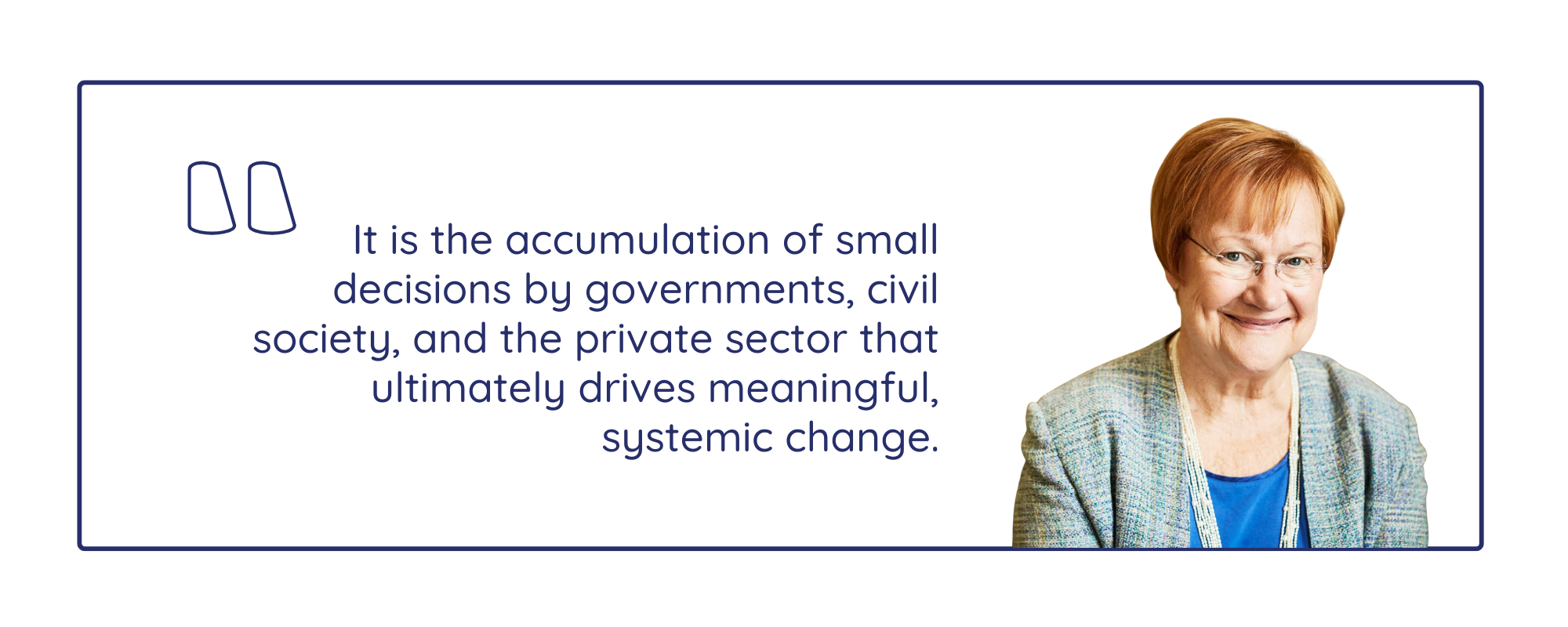
It is also crucial that the international community highlights positive progress, not only negative developments. We must communicate achievements and good results, particularly through the media, to maintain momentum and public support. From my perspective as a former lawyer in the trade union sector, I would add that corporations and enterprises also have a vital role to play. Even when political leaders falter, private actors can invest in democratic and equality initiatives. It is the accumulation of small decisions by governments, civil society, and the private sector that ultimately drives meaningful, systemic change.
This interview was conducted with the financial support of Club de Madrid as part of the “Beyond Beijing: Rethinking Women’s Political Participation.”
Image: ©megapolis, Wikimedia Commons (CC BY 2.0)