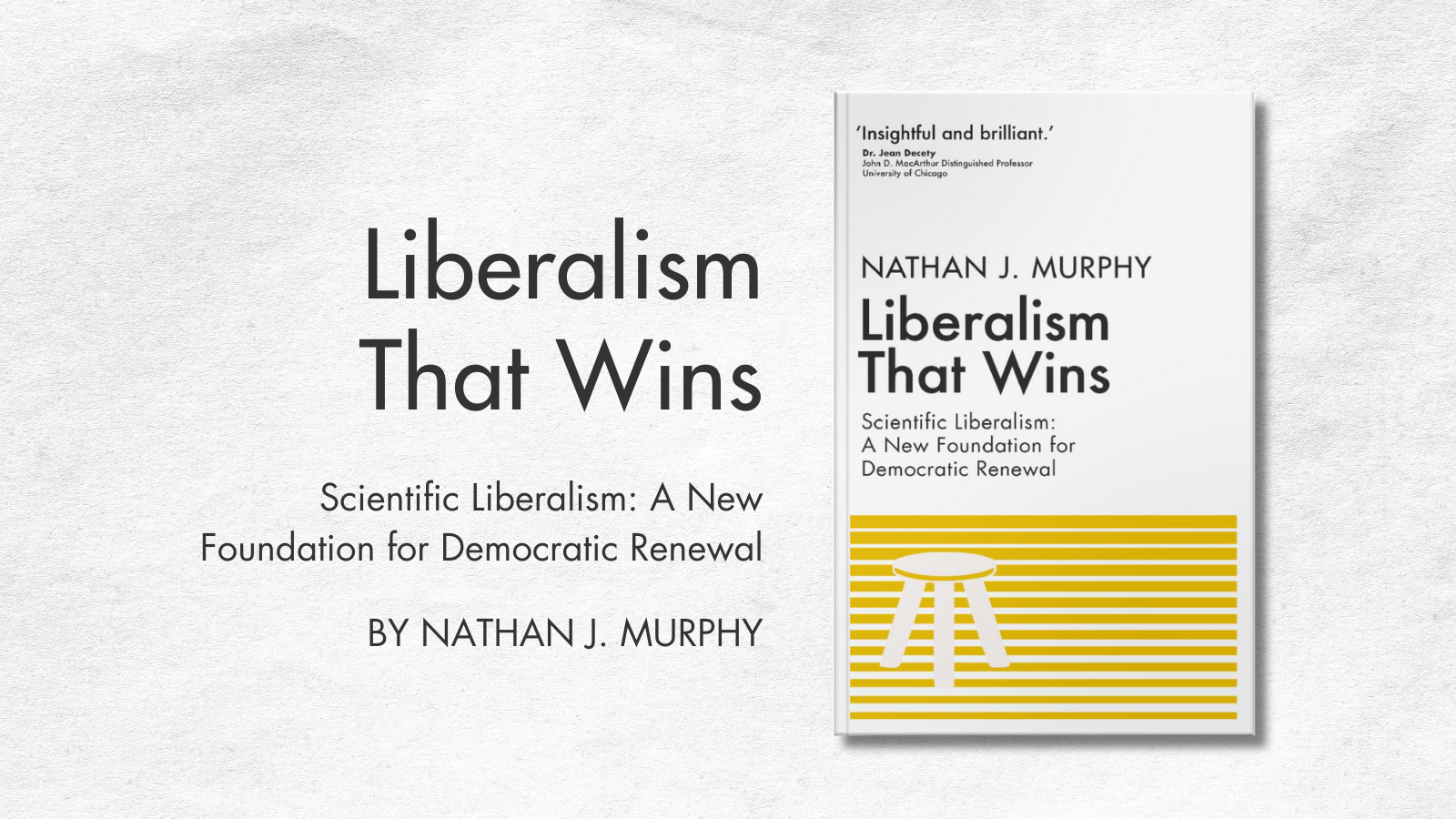
As liberal democracy comes under increasing pressure, Nathan J. Murphy’s new book – Liberalism That Wins – addresses core challenges of democratic politics through the lens of behavioural science and offers a psychology-based framework to rebuild democratic legitimacy. The European Democracy Hub interviewed the author.
Your new book calls for a “liberalism that wins”. What motivated you to write it, and why must liberalism change to preserve democracy?
I wrote the book after spending several years immersed in behavioural science to understand ideas, ideology, and political change. That work led to a behavioural understanding of political legitimacy – a finding with direct and timely application.
It is fair to say that post-war liberalism achieved a great deal, but its structural errors have compounded over time. Globalisation was treated as an unqualified good even as it hollowed out local industries and widened inequality. Financialisation shifted power from labour to capital. Sovereignty leaked into markets, treaties, and opaque technocratic forums, leaving people feeling their vote no longer mattered. Large-scale immigration was often presented as cost-free, even though the gains accrued mostly to those at the top while pressure on housing, wages, and services intensified at the bottom – fuelling backlash and cultural anxiety. Taken together, and poorly addressed by incumbent parties, these failures produced a legitimacy crisis.
The problem here is that the political centre is still hung up on these post-war assumptions, so it struggles to articulate a convincing vision of the future. This creates a need for a clearer organising framework to guide renewal – a new consensus.
My book, Liberalism That Wins, responds by returning to the fundamentals. Instead of adding new policies to a failing model, it asks what makes political systems feel legitimate in the first place. Its core thesis is straightforward: people judge politics through evolved moral instincts for fairness, care, cooperation, and group preference. When institutions align with those instincts, voluntary cooperation rises; when they don’t, trust erodes and coercion grows. The book distils behavioural science into a practical model of legitimacy, offering a basis for a more stable and adaptable democratic centre.
How must liberalism change? By aligning with how people really judge politics – the four instincts – and letting that shape institutional purpose. Such a behavioural framework may sound simple, but it is powerful. It can help reconnect the centre, restore trust, and anchor a new democratic vision in evidence rather than ideology.
You argue that democratic liberals ceded space to the far right by ignoring identity and belonging. Why?
Belonging isn’t a fringe concern; it’s a constant of human psychology. If you don’t address identity and belonging properly, public confidence weakens.
Voters want clear answers to three questions: Who are we? What are the boundaries? And will leaders protect group interests fairly? When the centre treats those questions as suspicious, bigoted, or contrary to market orthodoxy, it creates a moral vacuum that the far right can exploit.
Across Europe, when concerns about identity and belonging have been left unaddressed, the salience of immigration has risen – and with it, far-right support. The far right over-indexes on group preference and has little to offer in the other moral domains, so it routes almost every issue through identity. That dependence makes it especially vulnerable to credible, well-designed policy that satisfies group concerns.
What makes identity and belonging such a persistent force in political behaviour?
Identity and belonging persists because it is one of the oldest features of human psychology. Early humans survived in small, interdependent groups, where supporting kin improved the survival of one’s own genes. What began as kinship-based recognition now functions as pseudo-kinship, allowing trust and cooperation to scale beyond family lines. These instincts didn’t disappear; they expanded – through shared language, culture, and national identity. The underlying expectation remained constant: group membership should matter.
That expectation shapes political behaviour. People assume that the core benefits of belonging – fairness, protection, public services, economic opportunity – should flow first to insiders: not out of hostility to outsiders, but because belonging creates obligations of reciprocity. When political systems blur or ignore these boundaries, it affects their legitimacy.
Although immigration is the clearest flashpoint, it is far from the only area where group concerns arise. When foreign investment firms buy up care homes or water supplies, or extract profits without paying a fair share of tax, people recognise these as group concerns. They raise a basic question of whose interests the state is defending: those of the group, or those of actors with no reciprocal obligations. Group preference therefore extends well beyond border politics.
Many assume this instinct can be transcended through ideology, but it can’t. Like fairness, it can be suppressed for a time, but people eventually return to a baseline – sometimes overcorrecting in the process. That’s why we must work with identity and why the real challenge is doing so without empowering illiberal identity politics.
What are your ideas for building group preference into democracy without endangering it?
At a basic level, centrist parties must confront the identity question directly and balance it with the other moral instincts: fairness, care, and cooperation. The answer isn’t to deny identity – pretending borders, groups, or cultures don’t matter – because that simply ignores the moral category.
The framework proposed in the book can be interpreted differently, depending on political persuasion, but its practical application is likely to converge on similar themes.
It leans toward a civic – and demanding – approach to belonging: politicians should define the “we” by committing to shared rules and participation, provide clear pathways to residency and citizenship, pair integration compacts in language and civics with support, use tiered entitlements that expand with status and contribution, and guarantee equal civic rights once naturalised.
It points to a need for capacity-aware management: link migration flows to absorptive capacity – training pipelines, wage impacts, housing supply – and adjust intake when schools, hospitals, or housing are under strain; deploy targeted visas for proven shortages, with regular reviews to adjust intake if locals are being squeezed. This can turn flashpoints into predictable administration.
Outside immigration, it favours risk-adjusted openness and stewardship: guard the commons against extraction by curbing predatory models in essential services, apply ownership and control tests for strategic infrastructure and care systems, require transparency in media ownership to avoid undue foreign influence, ensure accountability for algorithmically promoted content, and cut off foreign – or even non-resident – money in elections and lobbying.
In trade, favour open societies and use rules-based tariff bands for politically distant regimes: prioritising growth within democracies, compounding toward a stronger democratic bloc, and creating clear economic consequences for democratic backsliders. Such an approach preserves openness without sacrificing sovereignty or legitimacy.
If carried out with moral alignment – in a fair, caring, and cooperative manner – these shifts would strengthen democratic legitimacy and help correct the overextensions of the post-war model.
Some critics argue that such an approach to group identity and belonging risks veering toward the far right. Your response?
It does challenge parts of the post-war orthodoxy that treat group ideas as suspicious – but it isn’t a right turn. Converging evidence across the behavioural sciences is clear: people care about belonging. We don’t have to like that fact for it to matter; politics still has to work with it.
If you’re on the egalitarian left and want generous out-group care, two things are essential: a strong, legitimate democracy and the ability to win and hold power. There’s a straightforward utilitarian argument here – out-group care must be sustainable and must not undermine democracy. Strong borders and clear rules can enable a generous centre.
Functionally, this framework enables the centre left to draw a clean line against leftist extremes: drop the self-negating pretence of no defined culture, open borders, or unrestricted benefits for non-citizens, and replace them with principled solidarity: fair entry, real integration, and equal civic status once citizenship has been granted.
It also enables the centre right to protect against ethnonationalism: group preference must be exercised fairly, with care, and balanced with cooperation. It recognises that group preference has limits; protectionism can become self-defeating if it strangles economic cooperation, and immigration can strengthen cooperation by easing labour shortages.
Boundaries exist in every real society; the question is whether you justify them in a way that balances values and protects dignity. The framework in Liberalism That Wins provides a bounded pluralism: group preference balanced with fairness, care, and cooperation. It is that demand for balance that protects against extremism.
So, rather than being a shift towards the far right, it responsibly removes the political terrain that the far right mobilises on.
How do you see the prospects for European governments to move this way and deal effectively with the far right?
I think the prospects are good if leaders pair moral clarity with enforceable rules. Denmark shows the centre can be firm and reasonably fair: the Social Democrats tightened and clarified immigration while investing in core welfare, pairing tougher integration with practical support, so that belonging felt reciprocal, not lax. Not every measure worked, and some remain contested, but Denmark is converging on a rules-based, welfare-anchored approach with broad political backing.
The result is that the far right lost its ability to leverage group issues. After peaking at 21% in 2015, voter support for the far-right Danish People’s Party slid to less than 9% in 2019 – and has shrunk further since then. Without the ability to weaponise group concerns, they lost their only route to popular support.
Europe’s political centre must be careful not to mimic the far right, as this only validates its rhetoric and behaviour. Instead, the centre needs a principled moral foundation for group questions that guards against cruelty and protects legitimacy.
Behavioural science provides the tools to do just that – helping deliver a renewed, legitimate democratic centre that can out-compete the extremes.
Liberalism That Wins is available now:
Amazon: UK / US / DE / FR / ES / IT / NL / PL / BE / IE
Also: Audible | Apple | Kobo
Author
Nathan J. Murphy is a political thinker working at the intersection of political theory, science, and philosophy. His research explores how insights from behavioural science can aid the renewal of liberal democratic institutions, connecting high-level analysis with real-world policy design. He is the author of The Ideas That Rule Us (2024) and Liberalism That Wins (2025) and founder of Prepolitica, a research and design initiative that develops frameworks and tools for democratic renewal. Based in Europe, he writes for audiences across policy and the public sphere.
This publication was produced with the financial support of the European Union. Its contents are the sole responsibility of the authors and do not necessarily reflect the views of the European Union.