Beyond Beijing: Rethinking Women’s Political Participation is a research project implemented by the European Democracy Hub in partnership with Club de Madrid, exploring the global progress made in aiding women’s political participation since the adoption of the Beijing Declaration and Platform for Action in 1995. As part of this project, the European Democracy Hub interviewed Danilo Türk, President of Slovenia (2007–2012) and Member of Club de Madrid.
What was the impact of the 1995 Beijing Conference on women’s political participation globally?
The 1995 conference was an optimistic moment in history, which was seized for a progressive cause. That forum also articulated a very clear principle: women’s rights are human rights. This is important; on the one hand, it’s a very simple principle and nothing new. Women are humans; therefore, they have human rights – nothing special. On the other hand, it was a recognition that the rights of women had not been respected and must be treated equally to other human rights.
This was the most important message of the Beijing Conference. It established a universal platform for cooperation, and at the time, political momentum allowed this to happen. This is not always possible, because political circumstances, ideological struggles, or other policy issues may prevent such cooperation.
Are there sufficient mechanisms in place to incentivise and effectively monitor progress towards women’s political participation?
The short answer is no. That’s very clear. The problem really lies in what kind of mechanisms are needed, because many of the issues that affect women cannot be addressed simply by multilateral cooperation, human rights courts, and other mechanisms of human rights protection. The challenge is deeply embedded in cultures and traditional practices; these are very much part of socioeconomic issues and patterns, which in our era place a disproportionate burden on women.
Thus, we also require more innovative mechanisms to address these challenges. This problem is widespread throughout the world, but it takes different forms depending on cultural norms, traditions, and religions. Therefore, we need local and tailored solutions, and this should be a priority.
What actions can be taken at the international or national level to more effectively support women’s representation in society and enhance their role in decision-making?
Things have to be done differently. Those who say things have to be done differently are not taken seriously, because everyone says this. The question is: differently how? We have reached a point of congestion. There is no shortage of international statements and aspirational language, but when it comes to action, it’s not taken very seriously. We have reached a point where we also see deficiencies, shortcomings, and negative consequences of this lack of action and political leadership.
What is the crucial thing to consider? I would say the social effects of development. The world needs to figure out better patterns of economic and social development, and this will require rethinking and redefining the role of women, as they make up half of the global population and are disproportionately burdened by the effects of globalisation.
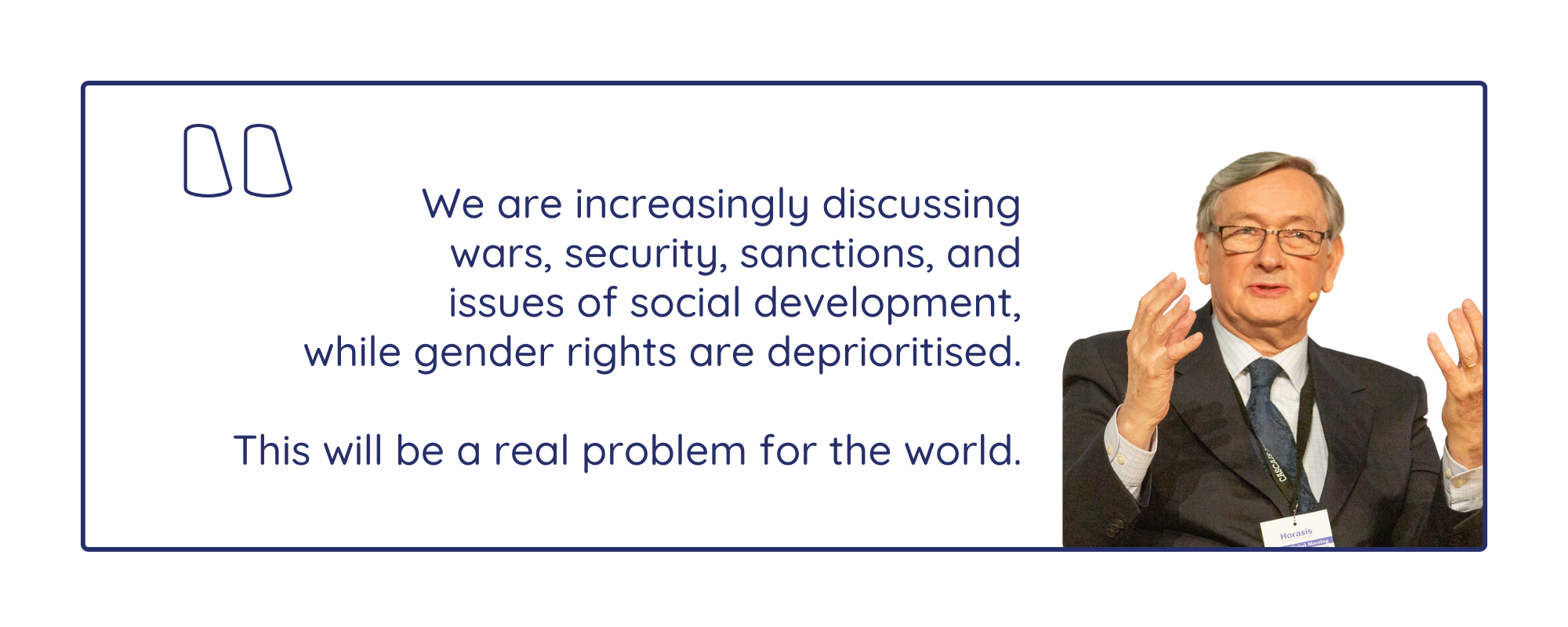
We need social justice; we also need a better balance in societies. And of course, the policies that could convince the international community that these challenges need to be addressed are not in place. We are increasingly discussing wars, security, sanctions, and sometimes even issues of social development, while gender rights are deprioritised. This will be a real problem for the world.
How can we ensure that women’s rights remain prominent in the multilateral agenda?
There is no single strategy. In the mid-1990s, there was momentum. The world was more constructive and open to discussions aimed at a common goal. Now, there is no such momentum. Amid the proliferation of conflicts worldwide, countries are increasingly concerned about peace and security as well as the changes in the global balance of power and the effects these have on the multilateral system. The momentum of the mid-1990s allowed for progress and global political commitment, but now we are witnessing serious setbacks, both in political commitment and in the state of women’s rights across many countries.
Therefore, we should not neglect the fundamental and existential rights of humankind. They include women’s rights. We should seek opportunities and build the necessary narratives to take advantage of current political developments. Certainly, this will require investment, political will, and financial resources, but this is the only way forward.
This interview was conducted with the financial support of Club de Madrid as part of the “Beyond Beijing: Rethinking Women’s Political Participation.”
Image: © Richter Frank-Jurgen, flickr (CC BY-SA 2.0)