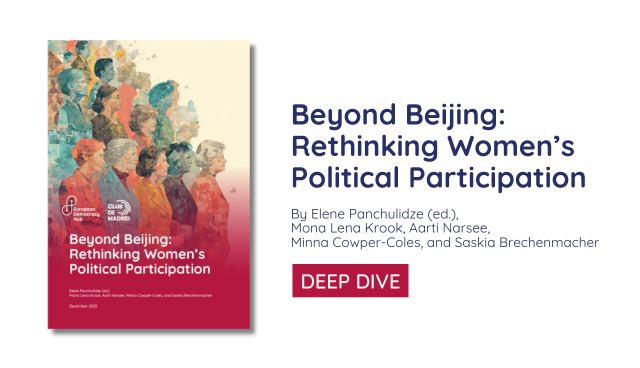
Beyond Beijing: Rethinking Women’s Political Participation is a research project implemented by the European Democracy Hub in partnership with Club de Madrid, exploring the global progress made in aiding women’s political participation since the adoption of the Beijing Declaration and Platform for Action in 1995. As part of this project, the European Democracy Hub interviewed Kim Campbell, Prime Minister of Canada (1993) and Member of Club de Madrid.
Have you helped advance any key objectives of the Beijing Platform for Action?
The Beijing conference took place just after I left office, but I have contributed to many related activities and initiatives since then. I am a founding member of the Council of Women World Leaders, established in 1996, which brings together 95 current and former presidents and prime ministers. The Council’s aim is to mobilise the world’s most senior women leaders to advance the status of women globally.
I am also a founding member of the Club of Madrid, composed of democratically elected heads of state and government. We have a significant number of women members, and all the projects we implement across both organisations have been strongly focused on supporting the advancement of women, particularly in leadership roles.
For instance, I was involved in a project focused on women in peace and security in the Horn of Africa. Our aim was to empower women with diverse networks across the region to advocate for their inclusion in post-conflict negotiations. This initiative was grounded in the UN Security Council’s resolutions, which assert that the absence of women in peace processes significantly undermines the sustainability of agreements.
In 2014, I launched the Peter Lougheed Leadership College at the University of Alberta and served as its Founding Principal. The programme complements the regular curriculum for third- and fourth-year students and was designed around a central question: What do leaders need to know? My answer was that leaders need to understand much beyond their immediate fields or daily lives. To address this, we created small, diverse student forums, bringing together participants from over ten different faculties and a wide range of backgrounds and genders. The programme drew heavily on insights from social and cognitive psychology, fostering broad-based learning and personal growth.
When I created the Leadership College, one of my goals was to equip future leaders with an awareness of the limits of their own thinking – not because anyone is inherently flawed, but because we are all shaped by the environments we grow up in. I know I am a much more open-minded and fair-minded person now than I was as a young woman. I grew up in a predominantly white, British-oriented society in Vancouver, where there was very little racial diversity. Today, my understanding of real-world challenges is profoundly different, shaped by experiences that have helped me grow, learn, and see the world more broadly.
How much has the landscape for women, especially in political participation, shifted over the years?
Since the Beijing conference, when I speak about the advancement of women, I can tell a reasonably positive story. The number of women in political office has grown, and their presence has become increasingly normalised. When I became Prime Minister of Canada in 1993, no one who looked or sounded like me had ever held that office. It was a bit of a shock, particularly for the Ottawa press gallery, which seemed to think it owned the political process, along with its implicit ideas of what a prime minister should look or sound like. Much has changed since then. Today, there is significant interest in breaking down barriers for women, not just in politics but across society. Advances in social and cognitive psychology have also helped us understand why these barriers exist and how they can be addressed.
When speaking about women’s issues, I eventually had to recognise that much of the optimism and positivity that once shaped my speeches needed to be tempered. Progress has always faced pushback. Sexism doesn’t disappear simply because there is broader global recognition of the value and contribution of women. Look at what’s happening in the United States with the attacks on diversity, equity, and inclusion (DEI). The whole purpose of DEI is to ensure that people aren’t excluded because of bias, and that everyone has the opportunity to contribute to the fullest of their abilities. Yet, DEI has been distorted to suggest that anyone from a marginalised group – any person of colour, any woman, or anyone who is not a white, straight man – has achieved their success through some unfair advantage or affirmative action, rather than through true merit. In reality, the opposite is often true.
As Charlotte Whitton, the first female mayor of Ottawa, once said: “A woman had to be twice as good as a man to be thought half as good.” Many people from marginalised groups who achieve remarkable success are often more qualified than the usual dominant groups, because they have had to overcome systemic biases to get there.
Has politics become a tougher arena for women, given social media and far-right trends?
The internet and social media have amplified voices of misogyny and racism far beyond what I experienced in public office. Technology has changed dramatically since then. Today, declining regulation and social media algorithms make it harder for politicians, as people can be insulated from opposing views even when they might be open to them.
It’s also crucial for those being marginalised to form alliances. Women need to recognise that people of colour, LGBTQ+ individuals, and other communities face similar challenges, and we must understand we are not alone in confronting these efforts to silence and exclude. I have been impressed by the European Union’s willingness to legislate in this area—though not all countries are the same, some have been braver than others.
Yes, it is harder today. There are more platforms for exclusion, and algorithms that favour conflict make it even more challenging. This is why we must think carefully about how we use social media and other digital tools.
What is the best way to gain support and allies for gender equality?
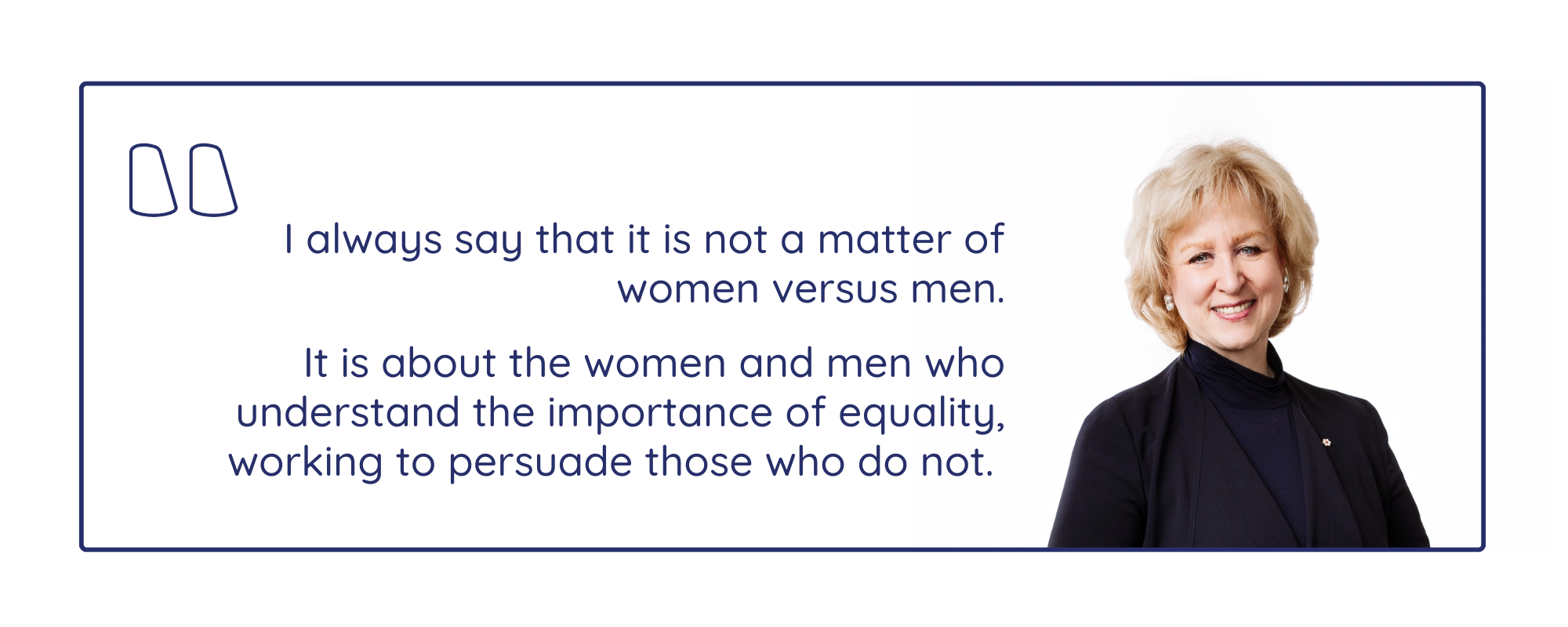
I always say that it is not a matter of women versus men. It is about the women and men who understand the importance of equality, working to persuade those who do not. Some of the strongest allies in advancing women are men who recognise the talent and contributions of women, who want to support them, and who are actively involved in processes that help create opportunities for women to succeed.
At the same time, we are now facing a very concerning rise in populism, which often works against the advancement of gender equality. Populist movements frequently attempt to roll back progress by attacking initiatives such as diversity, equity, and inclusion, claiming that efforts to open up competitive opportunities for those who have historically been excluded are somehow unfair. In reality, these initiatives simply seek to provide a fair chance for everyone to compete and contribute. The challenge we face today is to continue building broad-based support, to work with allies across different communities, and to ensure that the voices advocating for inclusion and equality are not silenced.
This interview was conducted with the financial support of Club de Madrid as part of the “Beyond Beijing: Rethinking Women’s Political Participation“