

Resisting InterScalar Authoritarian Networks and Coalitions
We are in an era of democratic erosion and authoritarian spread. Across Europe and beyond, even in long-established liberal democracies, autocratic appeal is no longer a looming threat; it is a lived reality. Democracy advocates and activists have invested significant resources to figure out how to resist authoritarian advances. Yet we still do not fully understand how and why authoritarianism spreads and, crucially, how to resist it. We argue that this needs a new conception of the geographies of contemporary authoritarianism and democratic resistance.
Authoritarianism is an interscalar phenomenon.
Authoritarianism is not just something that each country experiences or addresses on its own. It is not neatly contained within state borders. The authoritarian ideas, antidemocratic institutions and practices, surveillance and information manipulation technologies, and anti-gender policies that shape contemporary authoritarianism are produced and spread through interactions and mutual influence among myriad state and non-state actors. These interactions blur the lines between the local, the national, and the transnational, shaping authoritarian ecosystems that are at the same time embedded in specific contexts and thickly interconnected.
Effective democratic resistance will also need to be interscalar.
Democratic resistance will also need to be interscalar if it wants to prevent the further spread of authoritarian ideas and practices. This means that it depends not only on domestic reform at the national level, but also on the ability to understand and resist interwoven authoritarian influences.
RESISTANCE proposes an innovative framework that borrows from human and urban geography to better understand how authoritarianism and democratic resistance’s interscalar geographies shape contemporary politics. It co-creates knowledge and democratic resistance tools with policymakers, civil society groups, and journalists that confront interscalar authoritarianism in their daily work.
What we do
- Theorise a new framework of interscalar authoritarianism that borrowed from human and urban geography and equip democratic actors with updated knowledge of how authoritarian ideas, practices, technologies and policies spread, and how they can be resisted.
- Co-create practical resources, including an interactive digital tool for early warning and strategic foresight, and a democracy defence playbook to weaken autocratic appeal coalitions and strengthen democratic resistance.
- Map and explain how both autocratic appeal coalitions and democratic resistance coalitions emerge, operate and interact on the ground.
- Share the project’s findings and practical tools with audiences across Europe and beyond.
Focus areas
Lead: Andrea Cassani and Tiziana Corda, Università degli Studi di Milano (UMIL)
Citizen-level autocratic appeal
Citizens in democratic countries are a key target of authoritarian narratives and ideas. Complex interscalar information networks shape these ideas and the ways citizens respond to them.
We delve into how authoritarian ideas appeal to democratic citizens and how citizens may contribute to or resist their spread.
Sites
We will look at how authoritarian ideas are shaped and resisted on the ground in:
- Grünheide, Germany: What happens to citizens' attitudes towards democracy and each other when a Tesla Gigafactory comes to town?
- Accra, Ghana: How does disinformation spread among democratic citizens, and how is it resisted?
We will also make and analyse a new Citizen Vulnerability to Autocratic Appeal Dataset to better understand what drives citizens’ receptivity to authoritarian ideas.
Lead: Luca Tomini, Université libre de Bruxelles; Licia Cianetti, University of Birmingham
Autocratisation and resistance coalitions
Elected executives are often the main drivers of democratic backsliding and authoritarian rise. They embark on political projects to dismantle checks and balances, demonise and repress opposition, redirect economic resources to regime-supporting actors, and curtail political and media pluralism. Yet, they don’t do this alone.
We conduct systematic mapping and analysis of the interscalar coalitions of actors that either promote or resist the erosion of democratic institutions and the spread of authoritarian practices.
Sites
We will look at how authoritarian institutions and practices are shaped and resisted on the ground in:
- Istanbul Canal Development: How is authoritarianism entrenched and resisted in the shadow of city planning and the struggle for civic space?
- CPAC Europe conferences: How are authoritarian practices and resources shared across borders?
We will also make and analyse a new Autocratisation and Resistance Actors and Actions Dataset to understand which constellations of actors and actions are involved in spreading and resisting the global spread of authoritarianism.
Lead: Kris Ruijgrok, University of Amsterdam (UvA); Aleksandra Krstić, University of Belgrade - FPN
Digital authoritarian practices
Digital technologies play an increasingly central role in enabling and driving authoritarian practices. Surveillance and information-manipulation technologies are being deployed across different regime types, while the growing power of Big Tech companies and the cross-border nature of digital repression make this a global challenge.
We map and explain the spread of digital authoritarian practices (DAPs) to uncover the complex, interscalar ecosystem in which they are developed, commercialised, shared, deployed and resisted.
Sites
We will look at how authoritarian technologies are shared, deployed, and resisted in:
- Belgrade: How are surveillance infrastructures assembled, used and resisted on the ground?
- MILIPOL Paris tech fair: Who makes, sells and promotes digital authoritarian technologies?
We will also develop a new typology of Digital Authoritarian Practices (DAPs) to understand the ecosystems that enable or constrain them; and will talk to journalists and editors to understand the challenges and resources of independent media facing DAPs.
Lead: Conny Roggeband, University of Amsterdam (UvA); Mária Žuffová, European University Institute (EUI)
Anti-gender attacks on rights and policies
So-called “anti-gender” politics, including attacks on reproductive rights and LGBTQ+ communities, is central to contemporary authoritarian politics and is increasingly shaping its policies. These are driven by extensive networks of think tanks, churches, international organisations, transnational money flows, and local and national activists and politicians.
We examine how these interscalar anti-gender policy networks, operating both online and offline, function as conveyor belts of authoritarian spread. We zoom in on the understudied but increasingly contested area of education policies to understand how these networks work and how they can be resisted on the ground.
Sites
We will look at how authoritarian policies are spread and resisted on the ground by following the work of two organisations working for progressive gender policies in education:
- The Rutgers Expertise Center Sexual Health in Utrecht, Netherlands
- InTYMYta in Bratislava, Slovakia
We will also analyse parliamentary debates across European countries to map the actors involved in formulating, supporting, and justifying anti-gender policies and those involved in rejecting them. We will trace their online connections and communication flows to understand how online and offline anti-gender actors interface and how they are resisted.
Our approach
RESISTANCE is interscalar
RESISTANCE is site-based
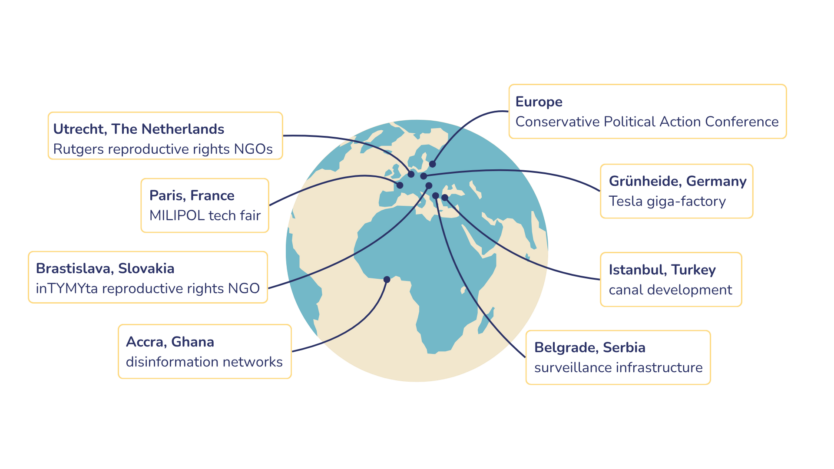
- Grünheide, Germany
- Accra, Ghana
- Conservative Political Action Conference (CPAC), Europe
- Istanbul Canal Development, Istanbul, Turkey
- Milipol tech fair, France
- Belgrade, Serbia
- Rutgers Expertise Centre HQ, Utrecht, Netherlands
- inTYMYta HQ, Bratislava, Slovakia